The Doppi Tradition
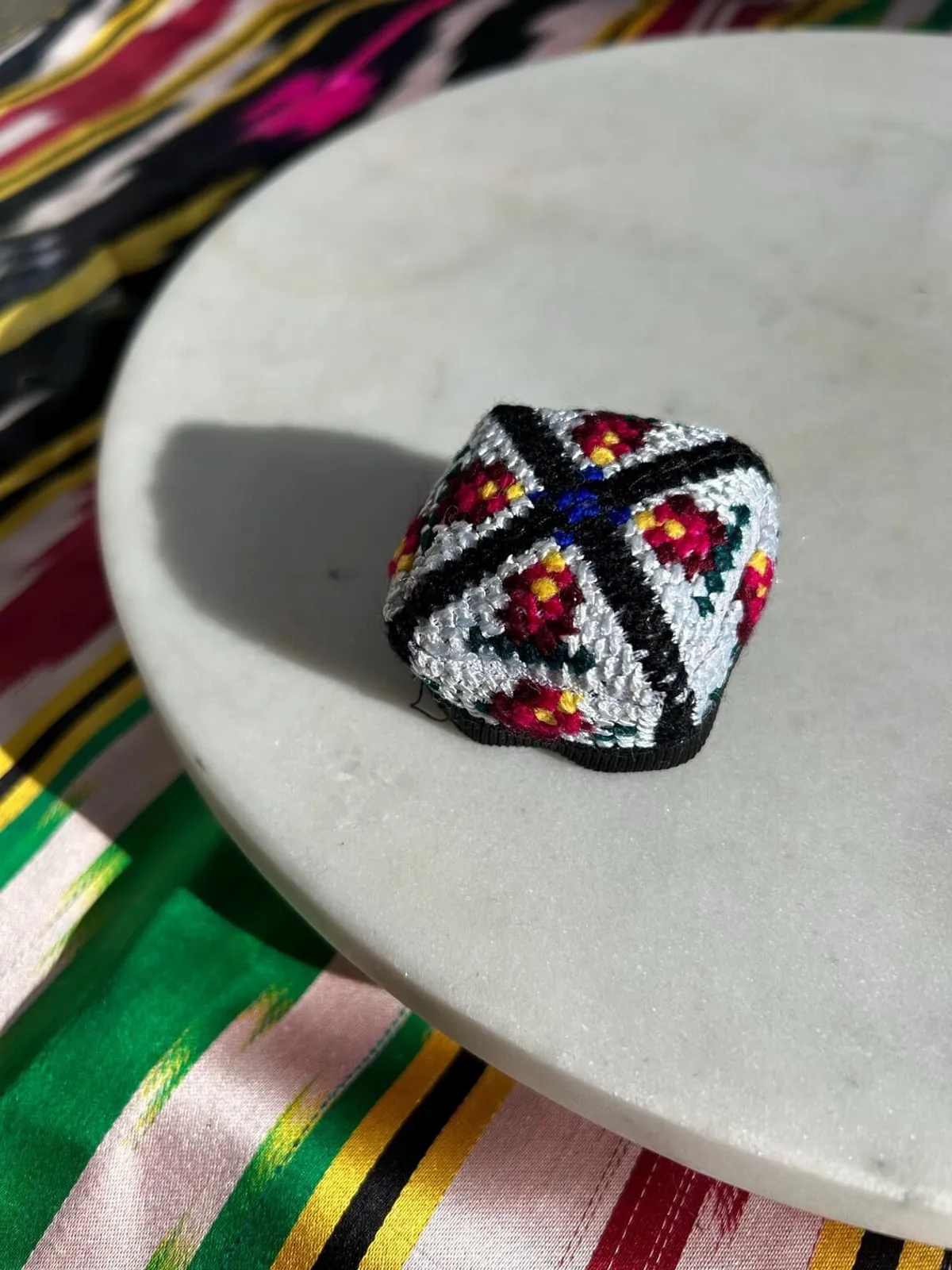
Doppi. Doppa. Duppi. The name shifts by region and dialect, but the shape doesn’t: a small, structured, four-cornered cap, worn close to the head, that reads instantly as Uzbek and more broadly Central Asian the moment you see one. It isn’t costume. People still wear a doppi to weddings, to holidays, to the mosque, and — in some regions — as an everyday piece of dress that never went out of fashion, because it was never really “in” or “out” to begin with. It’s closer to a flag than an accessory.
More than a shape
What makes a doppi legible as a doppi, and not just any cap, is the embroidery on it, and that embroidery is regional in a way that functions almost like a dialect. The most recognized version — black cotton or velvet with a white chain-stitched motif of almonds or pepper pods arranged around the crown — comes out of the Fergana Valley and gets worn nationwide, but plenty of other regions have their own colorways, motifs, and stitch techniques, each one identifiable to someone who grew up around it. A doppi tells you something about where its wearer, or its maker, is from.
Traditionally it’s a cap worn by men and boys, though women’s and girls’ versions exist too, often more colorful and worked in finer thread. It shows up at the milestones — a boy’s circumcision ceremony, a wedding, a graduation — as much as it shows up on an ordinary Tuesday, which is part of what makes it durable as a symbol. It was never reserved for special occasions only, so it never had to survive being retired to a museum case.
From the cap to the hair tie
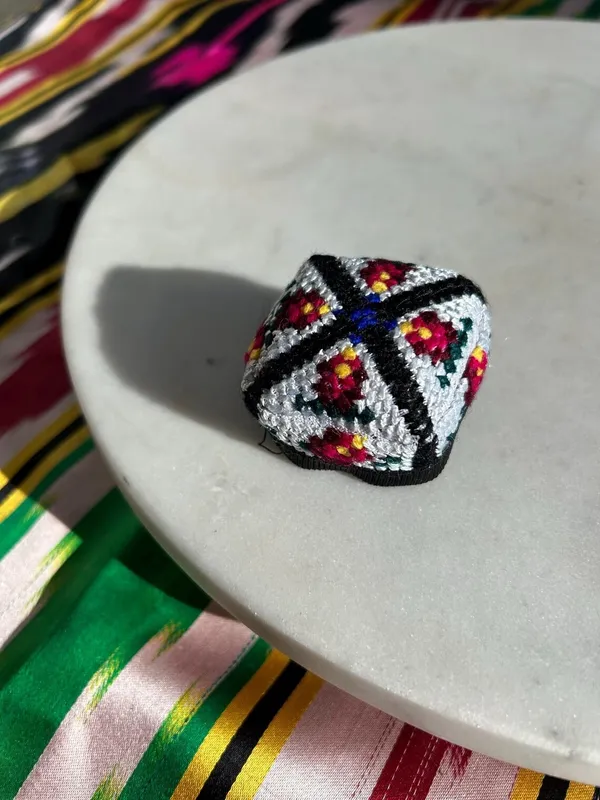
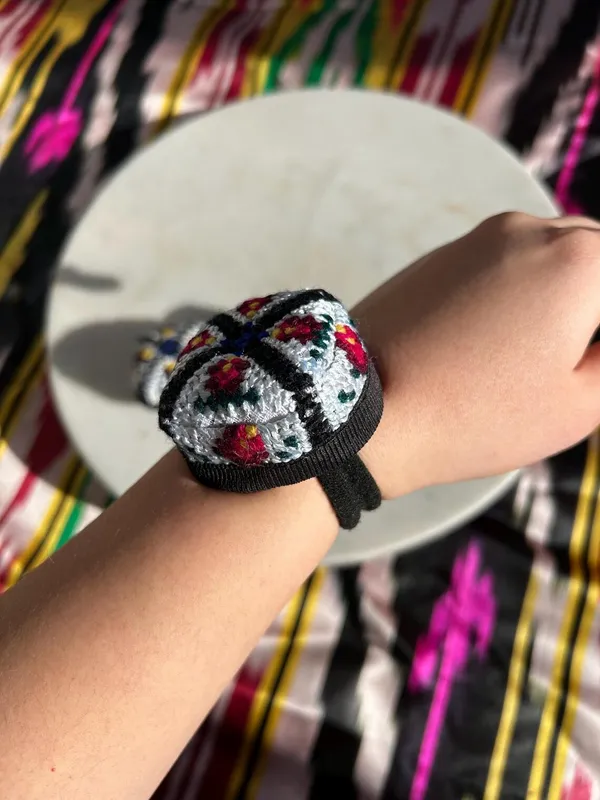
The doppi hair ties in the shop aren’t a print or an illustration referencing the cap from a distance — they’re a literal rebuild of it, at a wearable, everyday scale. Each one takes the same square, four-cornered shape and reconstructs it at about two inches across, in atlas ikat silk instead of the traditional embroidered cotton or velvet, wrapped over a soft elastic cord so it actually functions as a hair tie rather than a keepsake.
Shrinking the shape down doesn’t shrink what it’s carrying. Wear one stacked with a few others, or keep a single one on your wrist between uses, and you’re keeping a small, working piece of the same textile lineage as the cap itself — recognizable to anyone who already knows what a doppi is, and worth explaining to anyone who’s asking for the first time.